Prato has a population of less than 200,000 but is the second largest city in Tuscany after Florence. We had discussed meeting Robin and Inge there but that wasn’t going to work because of Inge’s work schedule. I still wanted to go to Prato because there is a Caravaggio and also nearby is a Pontormo masterpiece.
Getting from Florence to Prato is easy—20 minutes on the train but seeing the paintings was another issue. Both are in places only open Sunday and require reservations.
I started at Villa Medici Poggio e Caiano, also called Ambra because of the nearby river, and is located in Poggio e Caiano 17 km from Prato Centrale train station.

Poggio e Caiano originally was surrounded by countryside because extensive farming experiments were conducted from the villa by the early Medicis. It’s now in the middle of the village.

It was built in the late 15th century by Giuliano da San Gallo commissioned by Lorenzo Il Magnifico. It was used by successive Medici generations, then by Napoleon’s sister Elisa (who was given the title Princess of Lucca), then by the first king of unified Italy, Vittorio Emanuele II, when Florence was the capital of Italy, and is now owned by the Italian state.

The villa is based on ancient Roman villas. The external staircases and clock were added in the 19th century—which ruins the Renaissance-look of the exterior.

You have to go with a guide who makes you go into every room. You could do an audioguide in English but I opted to listen to the live Italian guide.
Inside reflects various additions and renovations over the centuries. The theatre was built for Cosimo Medici III’s wife, Marguerite Louise d’Orlean, who was a cousin of Louis XIV of France. Apparently she hated her mother-in-law who ruled over life at Palazzo Pitti so after bearing three children, moved to the Villa.
The painted backdrop (one of many) was added by Elisa Bonaparte later.

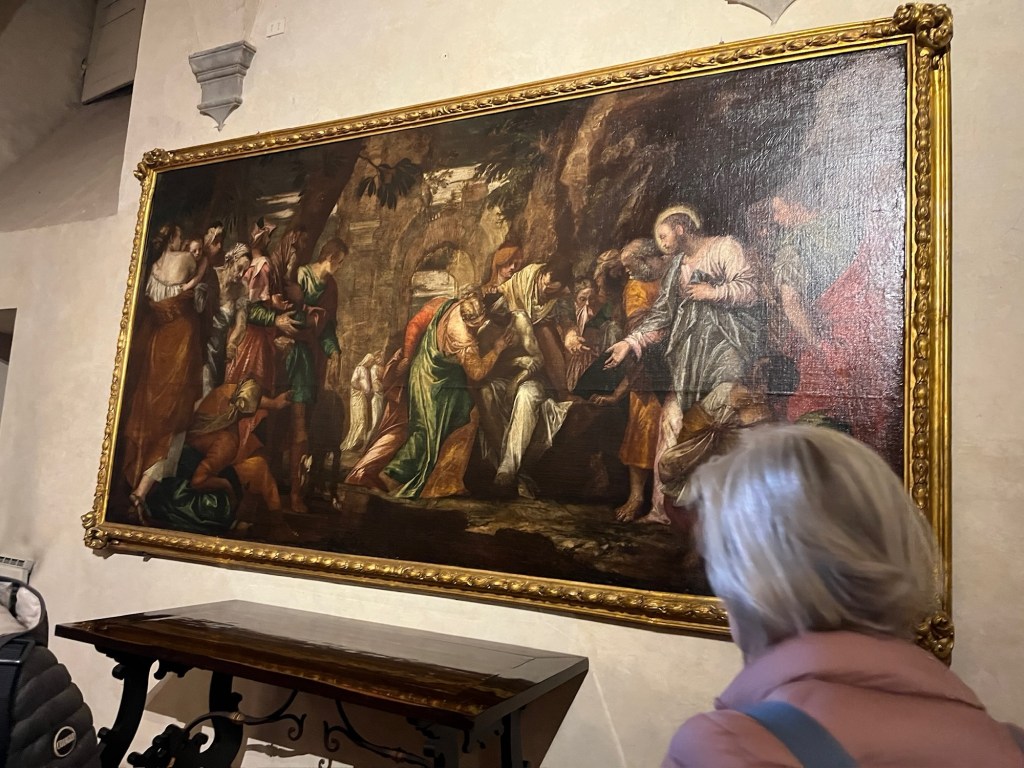
There’s a Veronese.
One of the original rooms are the apartments of Francesco I Medici and Bianca Cappello, his lover and later second wife. The two of them died within hours of each other purportedly from malaria but research showed they both had arsenic in their system and Francesco’s brother, Ferdinando, is usually pointed to as the poisoner. He hated Bianca Cappello because she was a commoner, and adulteress when Francesco’s first wife was still alive, and he did not want their illegitimate child to become grand duke. And the fact that Ferdinando would become grand duke upon his brother’s death didn’t hurt the theory that he arranged the assassinations. That he was a cardinal did not seem to stop the speculation.

The face of the telamons (the statues supporting the mantle) is supposedly Francesco and the woman on the fire screen is Bianca.

The saloon was built by Giuliano di Medici, son of Lorenzo Il Magnifico, who would become Pope Leo X and thus the papal symbol along with the Medici in the ceiling.
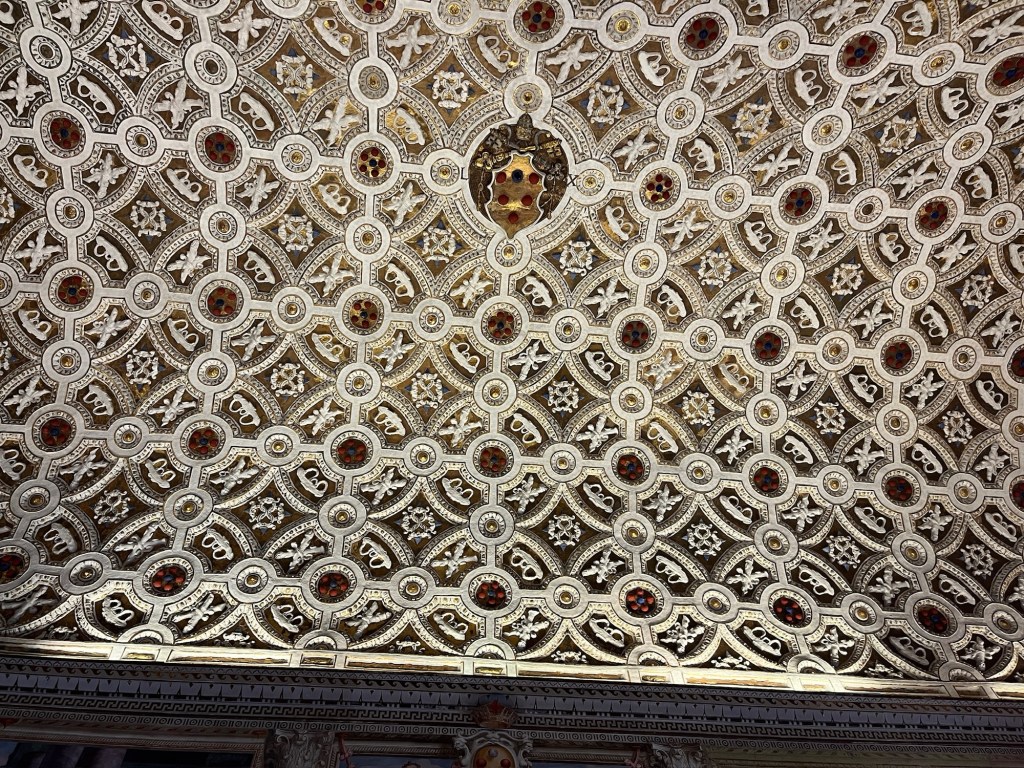
The walls feature frescoes by Pontormo, del Sarto and Allori, all very good Renaissance/Mannerist artists. The theme was historic events but allegories in praise of the Medicis especially Lorenzo Il Magnifico.


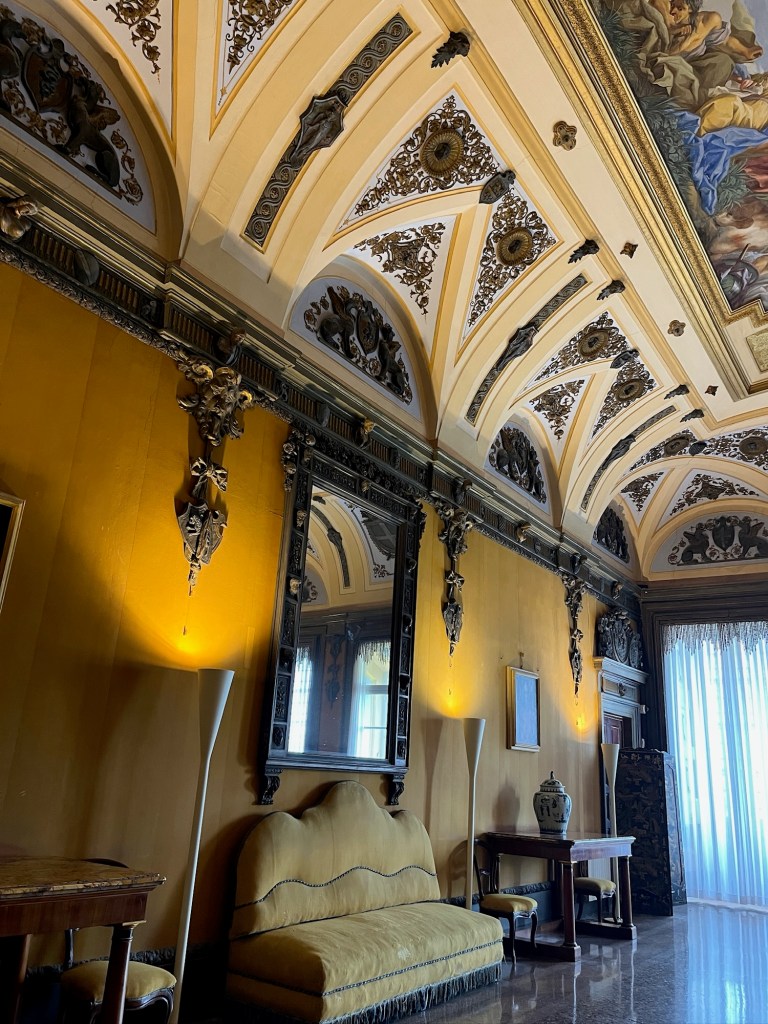
The billiards hall was done by the Savoys, the family of the first king of Italy. Since they didn’t work, they had lots of time to play. One table is at least twice the size of a regular billiards table. The decor is (to me) not tasteful in its attempt to create a pergola—it is too busy and confusing.

Interesting how some rich people have good taste but others do not, but because the latter are rich, they can build ugly expensive things. More excessive decoration by the Savoys in the below photo.
Hall of the Frieze has the original frieze which is on the front of the Villa. It is full of Platonic ideas which were much discussed in the neo-Platonist circles patronized by the early Medicis, Cosimo the Elder and Lorenzo Il Magnifico.

The images are subject to much interpretation; for example, the below has been suggested to be Plato’s idea of using the intellect to tame the passions.

The same room also houses Pontormo’s Visitazione (Visitation), the altarpiece from the church of San Michele e Francesco in Carmignano. It was restored and in 2024 brought to the Villa because the church is closed (I think they said for restoration). It is a Mannerist work which shows the muscularity and colours of Michelangelo. Interestingly, this shows the Virgin Mary meeting her cousin Elizabeth and the faces looking forward are also them.

The Villa makes you visit the rooms first, then the museum.
You have to leave the piano nobile (second level by North American counting) go to the ground floor then re-enter and walk up the staircase (or use the ascensore (elevator)) to go to the piano secondo (third floor) to continue the visit in the museo della natura morta (still life museum) which houses the Medici collection of still life and some Medici portraits.

The Medici who collected the still life paintings were descendants of Cosimo II (the son of the killer of his brother Francesco) and a Hapsburg. Their descendants all have that awful Hapsburg jaw and lips. I didn’t take any photos. Nor were the still life paintings worth much aesthetically but Cosimo III commissioned paintings which documented every variety of fruits and vegetables that grew on the Medici villas (there were 14 of them—villas, I mean). The many paintings make for interesting scientific agricultural history records as they not only show what they looked like, but they also list the names.


I paused for lunch at a restaurant near the Villa and tried mortadella di Prato. It differs from mortadella made in Bologna; the meat has less fat although it still has small pieces of fat and is made with red wine making it almost purple in colour rather than pink like Bologna’s version. I forgot to take a photo. It was served with stewed carciofi (artichoke) and a green salad and breads.
My next reservation was at Palazzo degli Alberti — a 13th century building converted into a museum during Covid, 2020-2023. It houses the collection of the Intesa bank, a collection which had been owned by two previous banks. Not sure how that came about. Naples has a bank that also owns a collection of art that includes a Caravaggio.

Annoyingly, I arrived early but they made me wait until my reservation time although there was no one else at the museum.
A guide/guard takes you up a staircase and lets you into the collection through a locked door. The set up includes laser-like monitors and unfortunately, I set off alarms twice trying to look more closely. After that the guard/guide really kept an eye on me—although there was no one else for her to watch.

The guard/guide offered to give me a guided tour (in Italiano) but I did not want to look at everything. The museum has three great works:
Filippo Lippi (Madonna del Ceppo) which shows the influence of Massacio. Filippo Lippi lived in Prato and was where he, an ordained priest, met Lucrezia Buti, a nun. Together they had Filippino Lippi, a painter whose works I’ve mentioned can be found in the Brancacci Chapel and Santa Croce in Florence.

Giovanni Bellini (Crucifix with Jewish Cemetery) is set supposedly in Jerusalem, thus the Jewish cemetery, but the landscape includes recognizable features from Venice, Ravenna and Vicenza. It was exceptional when it was painted (ca 1501) as it uses the image of the crucifix as a meditative object and not the usual depiction with people at the feet of the cross. Fra Angelico and others would later create many similar crucifixions.

and a disputed Caravaggio (The Crowning with Thorns)

I say disputed because of the provenance of this work. There is a document signed by Caravaggio to provide a crowing with thorns painting for Massimo Massini, a Roman cardinal, but the trail to this painting isn’t complete. Details, like size, seem to fit the commission. Roberto Longhi, who revived Caravaggio’s reputation in the 1960-70s, thought this was a copy, but Mina Gregori, an Italian art historian, saw this painting, had the owners restore it (because it had overpainting) and had it x-rayed. The x-rays showed pentimenti, traces of paint which reveal where the artist changed the design. No copy ever has pentimenti. So most art historians now think this is a Caravaggio despite the incomplete provenance.
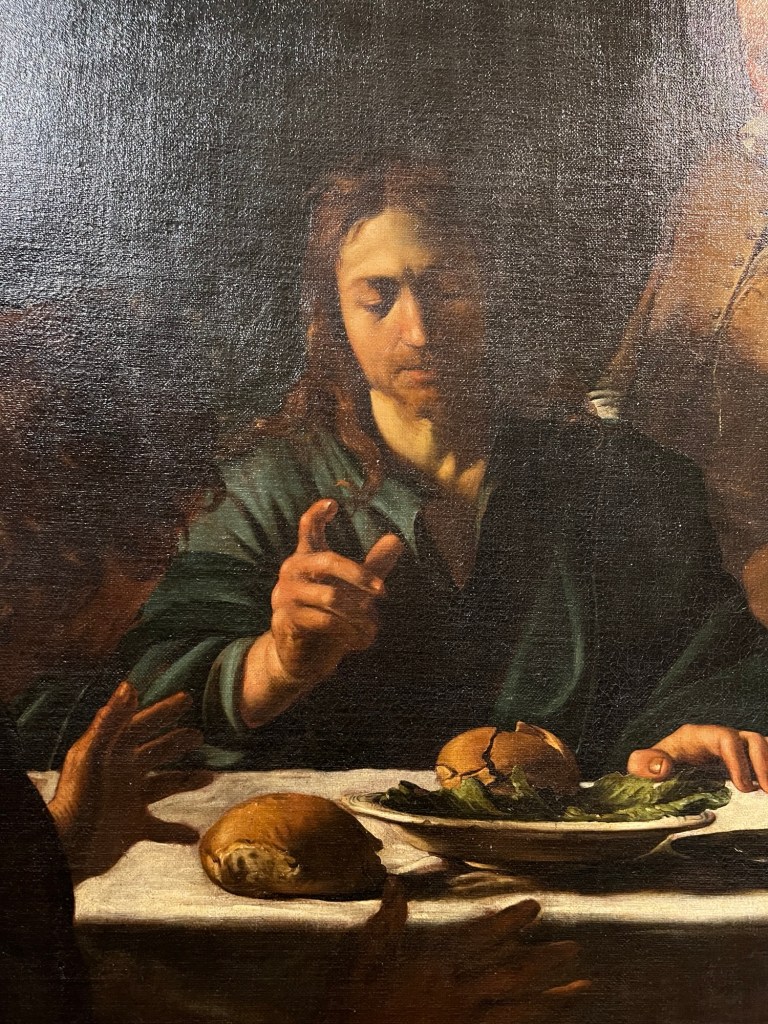
I found the hands particularly interesting.

They made me think of Caravaggio’s Supper at Emaus in the Brera in Milan.
I would have liked to go to the Duomo, the Cattedrale di Santo Stefano, as it has frescoes by Fra Filippo Lippi, and a pulpit designed by Michelozzo and Donatello, but it was Sunday, and mass makes it difficult to visit and I needed to get back to Florence.
Just going to have to return some day.
 LHWatson's Travel Blog