Sansepolcro (population 16,000) formerly called Borgo Santo Sepolcro, in province of Arezzo in region of Tuscany, is on the Tiber river. According to tradition, two 9th-century pilgrims to the Holy Land brought a stone from the Church of the Holy Sepulchre in Jerusalem (thus, San Sepolcro which means Holy Sepulchre). They were taking the stone as a relic to Rome (or Florence) but when they got to the site where Sansepolcro now exists, the stone became so heavy they couldn’t lift it. Another version is the stone flew out from their possession and imbedded itself into a walnut tree at the site of Sansepolcro. They built a chapel (at the location of the current Cathedral of Sansepolcro) as a home for the holy stone. The chapel was raised to the rank of Benedictine Abbey of Sansepolcro (the Badia). Still later it became the cathedral.

This is the city where Piero was born and eventually returned to, died and was buried. We spent the morning looking around the city and the afternoon in the museum to see his two major works.
Sansepolcro during Piero’s time was under the rule of Florence but with some measure of independence. Piero’s Resurrection is interpreted as referring to the founding myth of the stone from the Holy Sepulchre as celebrating the identity of the city.
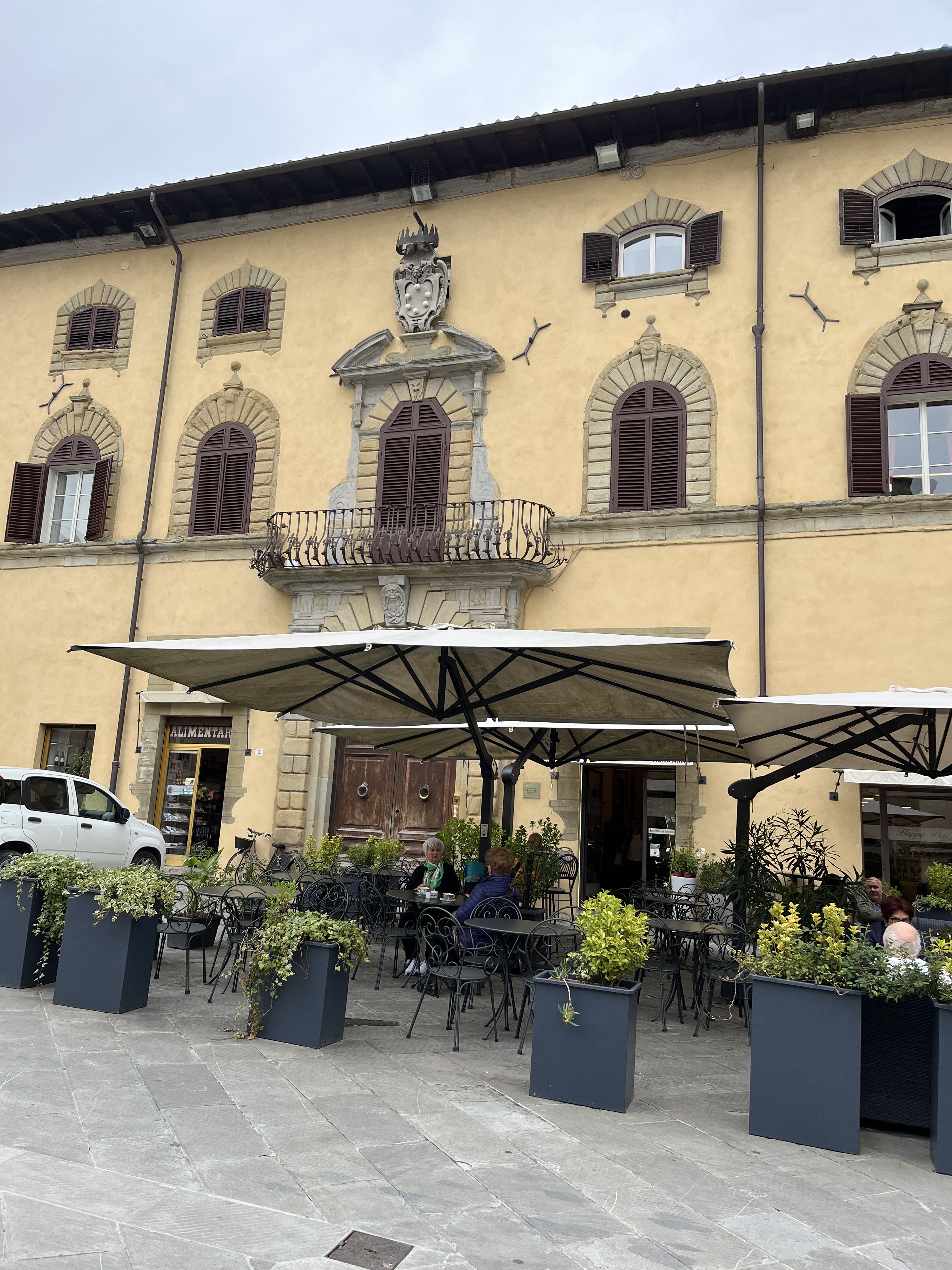
Inside Sansepolcro’s Gothic town council building, Residenza, now Museo Civico, an art gallery, is Piero’s Resurrection painted in 1463-65.

Christ stands in his sarcophagus, one foot resting on the edge, carrying a standard. His figure and features have that dreamy Piero quality. The soldiers who were supposed to be guarding the tomb lie asleep in the foreground (one is said to be a self-portrait of the artist – the sleeping soldier in brown armour on Christ’s right). The painting has two vanishing points – one is in the centre of the sarcophagus as we look up to the faces of the soldiers, and the other centred on Christ’s face. It makes the viewer feel like they’re standing right in front with the soldiers.
There’s a story that in WWII the church and the painting were saved from destruction when an English artillery officer named Tony Clarke disobeyed orders to bomb the town, because he’d read Huxley’s opinion of the Resurrezione as the best painting (though he hadn’t seen it himself). He’s a hero in Sansepolcro, and they’ve named a street after him.
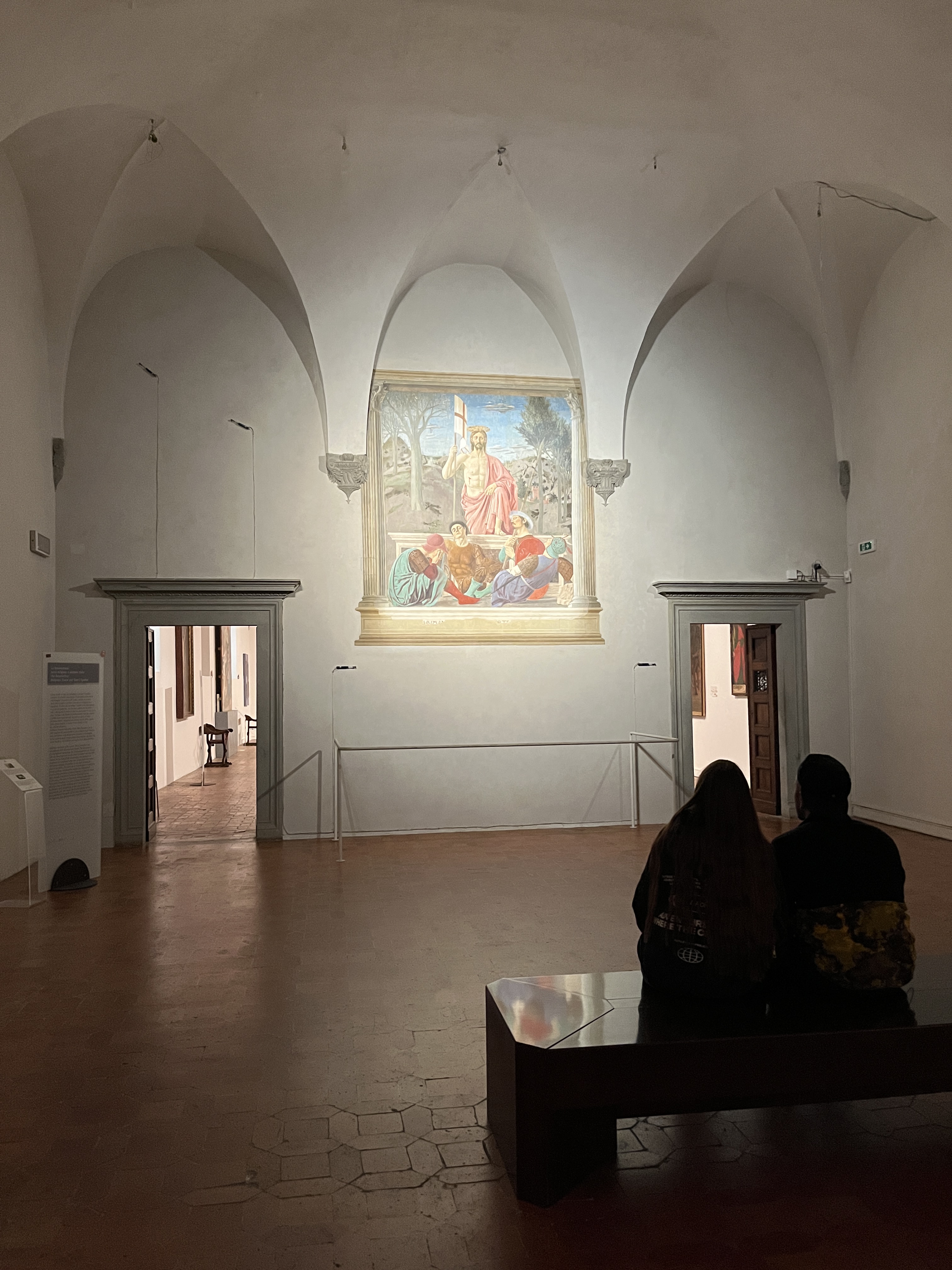
The Ressurezione was painted on a wall in the Residenza and at some point soon after was moved and thus the awkward fit of the sides, the colour variation around the edges and the missing bits at the bottom. A stylized version of the painting has become the city’s symbol.
The other major work is the Madonna della Misericordia altarpiece painted for the confraternità Misericordia. We looked inside the confraternity’s building. By way of background, a confraternity is a secular society which does charitable work. Membership is important for social status and often to participate in local civic government.
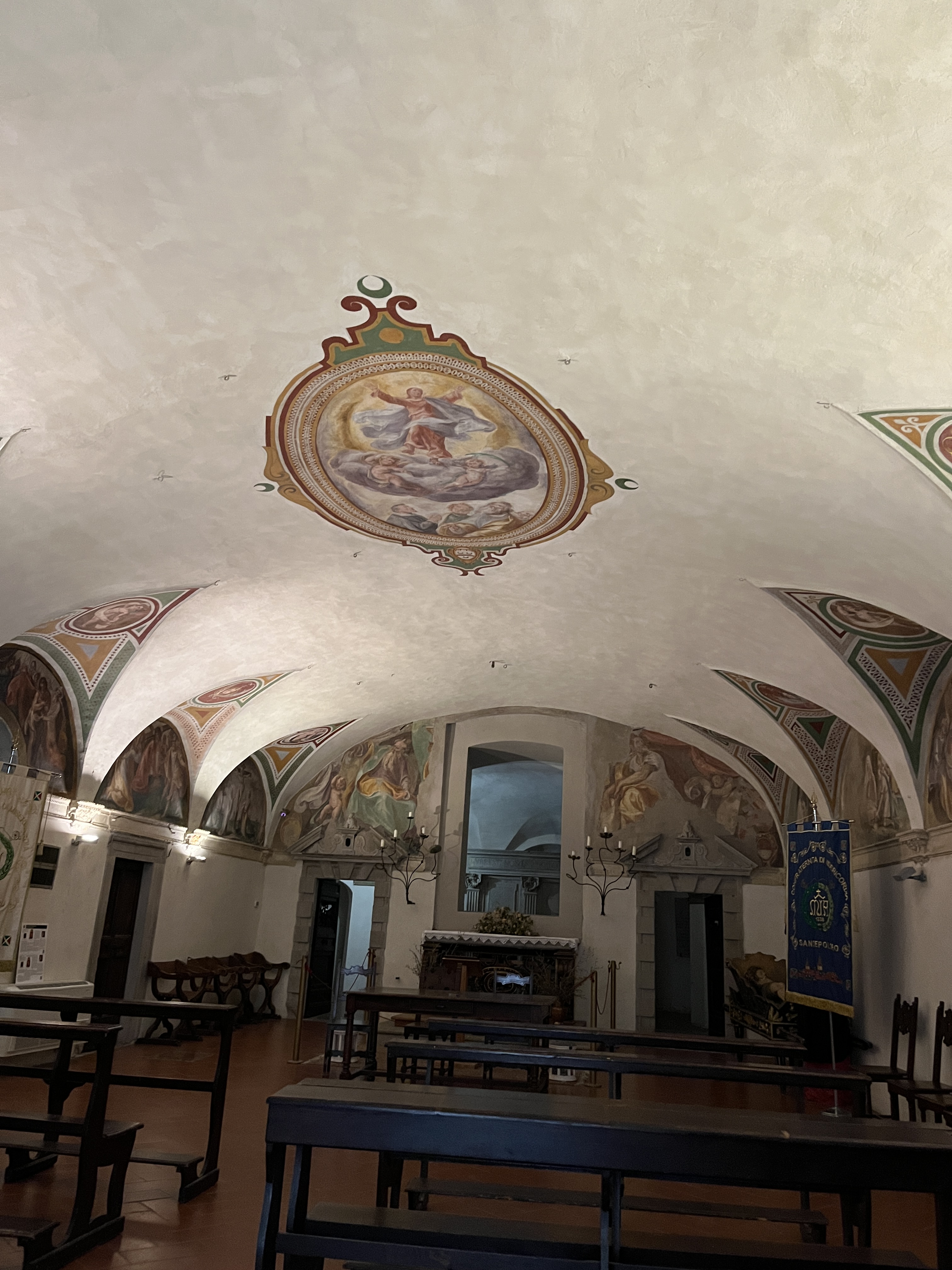
The painting is also now located in the Civic Museum.
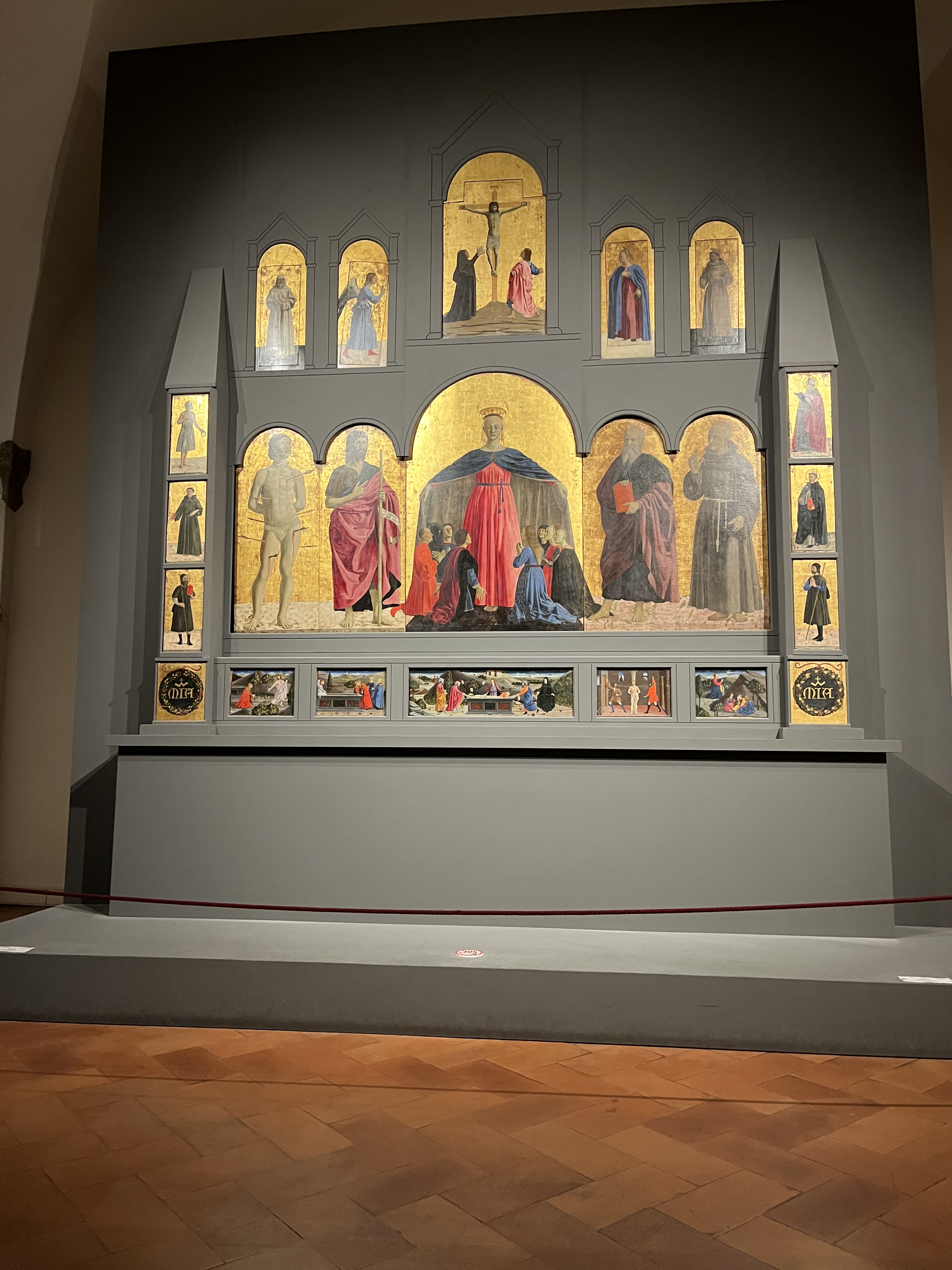
It likely shows confraternity members protected by the tent-shape of the Madonna’s robe. This is a very early work. The use of a gold background was probably something Piero wouldn’t have chosen, but perhaps was required by the patron. It didn’t allow him to work in perspective and to create realistic spaces. He worked on it in two phases. He started in 1445 but did not finish until 1462.
The museum also has the altarpiece which was the setting for Piero’s Baptism of Christ which is now in the National Gallery in London. Piero never finished the altarpiece and another artist was hired.

A computer image shows what the original might have looked like— the different styles do not seem to fit together. Richard Stemp suggested the gothic gold might be seen as a precious setting for the main painting. And there is likely a missing piece showing God above Jesus and John the Baptist.
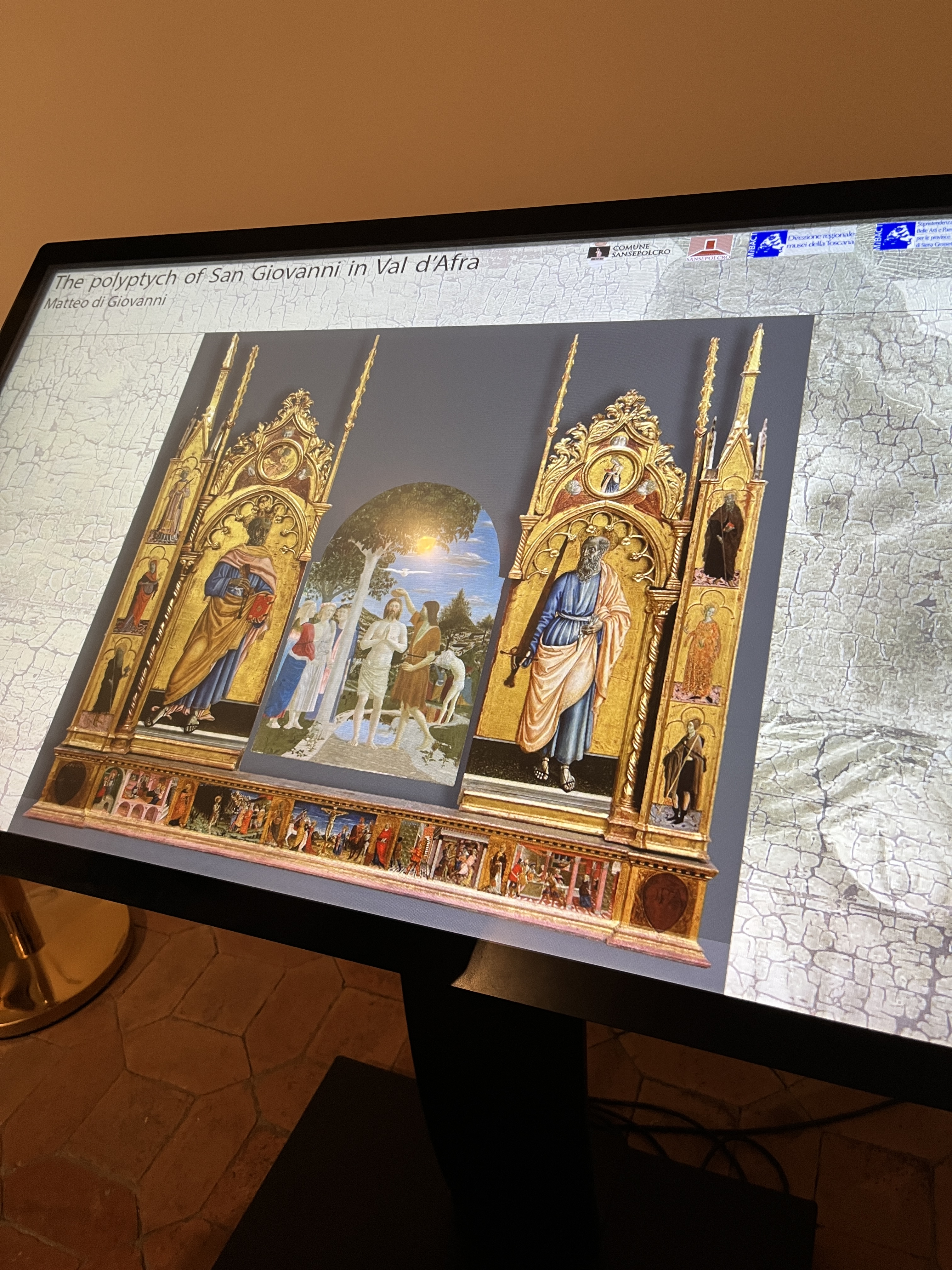
Piero seemed to have taken a long time to finish things or perhaps was doing too many things at the same time. The Baptism was in the cathedral of San Giovanni Evangelista.


The church has an amazing alabaster rose window which is not done justice in this photo.

It also has a Perugino, Raphael’s master, who we should see more of in Perugia, his home town.

The church of San Lorenzo does not have a Piero but has a recently restored Rosso Fiorentino, a Mannerist painter. This is a late work, a Deposition from the Cross. I looked a lot at Mannerist paintings in Florence in May 2023.

This building was Piero’s family home.
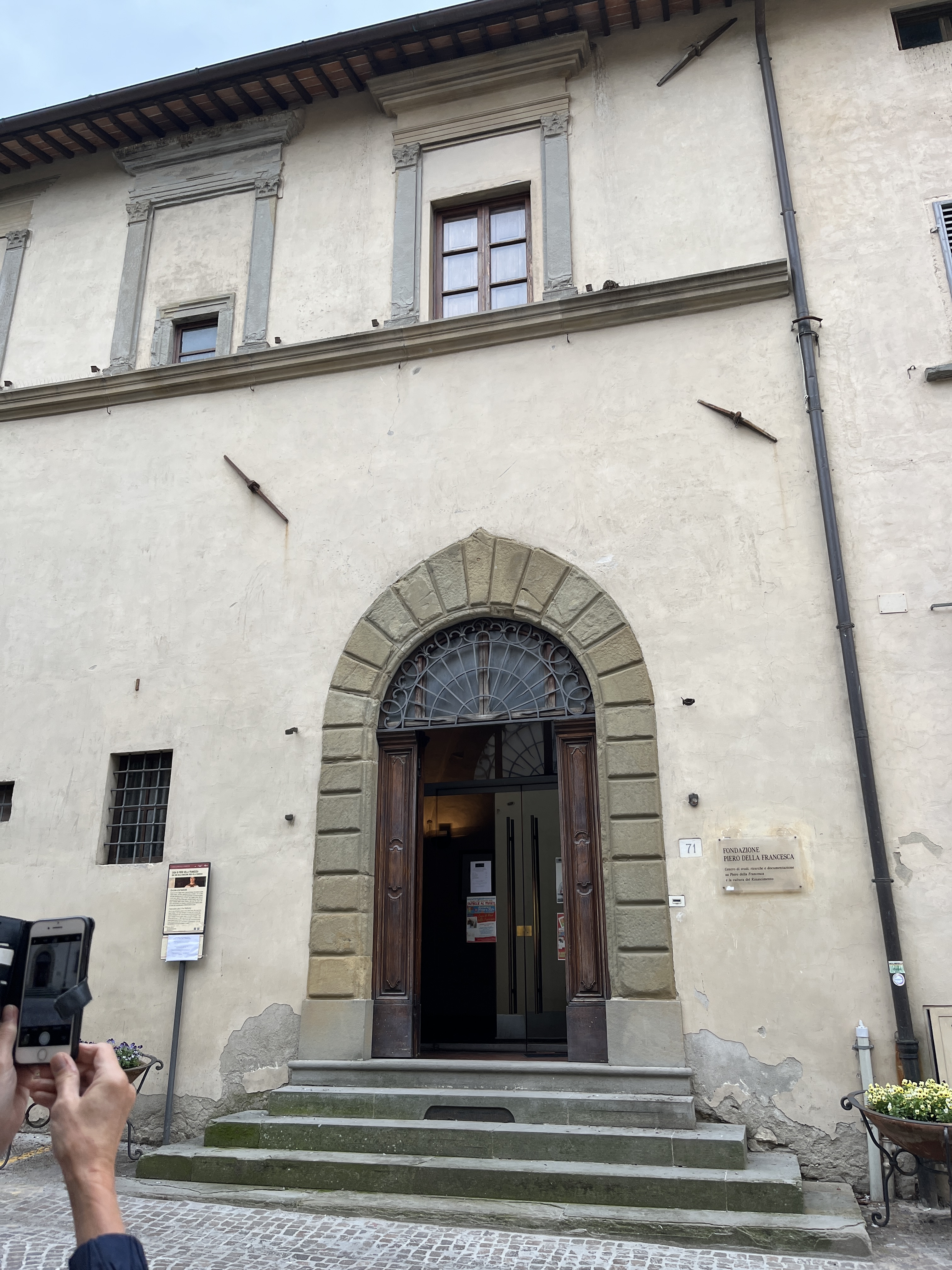
Piero’s home used to have a painting of Hercules which is now in the Isabella Stewart Gardner museum in Boston.
 LHWatson's Travel Blog