The “outdoor” dining room of this hotel is one of its best features.
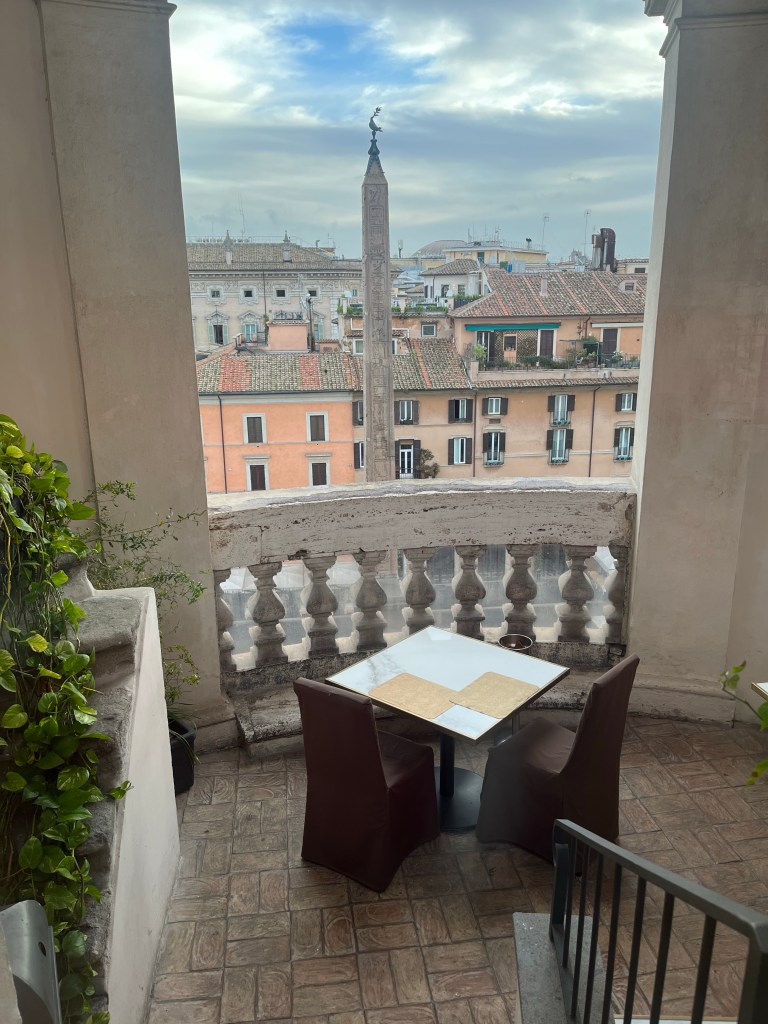

The tower is part of Sant’Agnes in Agone.
I sat on the part of the terrace with plastic walls. The 12 degrees is considered too cold for the open air portions
As an aside, “Agone” refers to Piazza Navona, which name comes from the site as a foot race track. I’ve read “agone” or “agon” in Latin means the place of the competitions or to describe the shape of the track which was an oval that was flat on one end. “Navona” also derives from the same word.
The indoor dining room for dinner has some pretty great views as well.


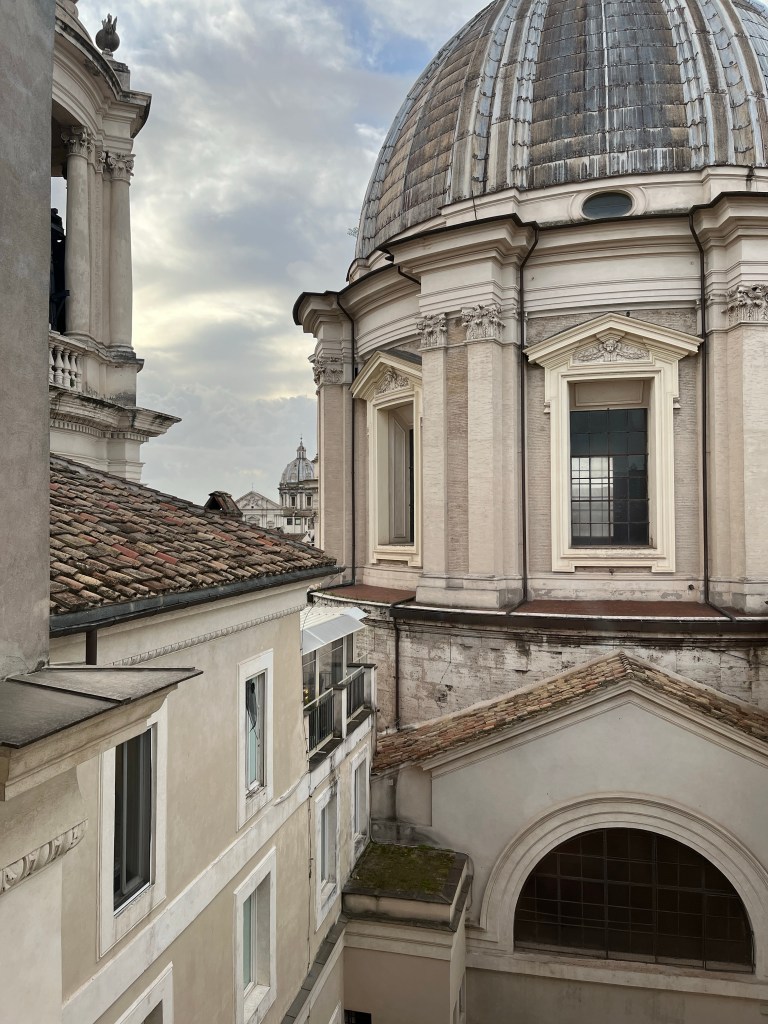
The view of Sant’Agnes across the inner courtyard from the 5th floor.
I have to confess to a huge mistake I made yesterday. I could edit but—mangez la verre (Allie and Sid’s phrase for owning your mistakes which comes from some cartoon I don’t know).
I said I could see the Wedding Cake, but that monument is about 90 degrees east from my view. What I’m looking at, which I could read in the morning light, is “Corte Suprema di Cassazione”, Italy’s Supreme Court.
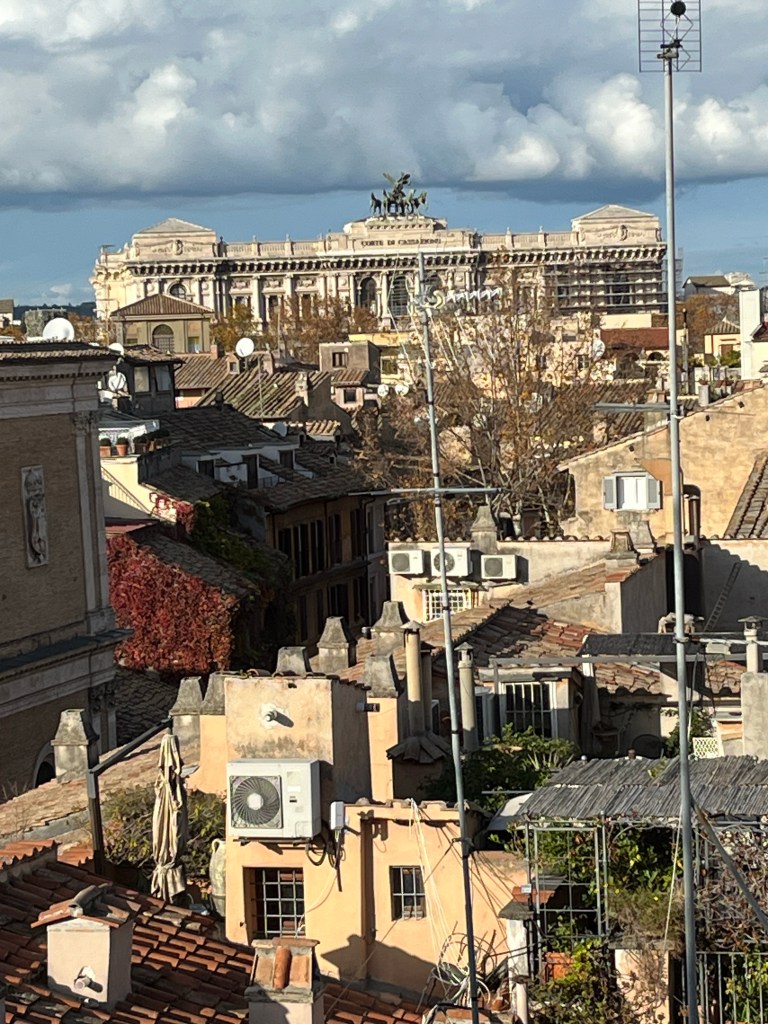
Both edifices have horse drawn chariots on top but the Wedding Cake is much whiter and taller. I expect I will eventually post a proper photo of it but I didn’t see it today.
After breakfast I joined an urban sketching Rome lesson. We sketched Santa Maria della Pace, which facade was by da Cortona.

The weather prediction had a possibility of rain but it turned out intermittently sunny and not too cold for sitting outside.
The instructor was Fabio Barilari, who is an architect and teaches drawing to architects, in addition to people like me. So he provided instruction about sketching buildings and also a bit about watercolour painting, as well as answered all my questions about Renaissance and Baroque architecture in Rome and discussing Frank Lloyd Wright and Frank Gehry (Franco as Fabio called him).
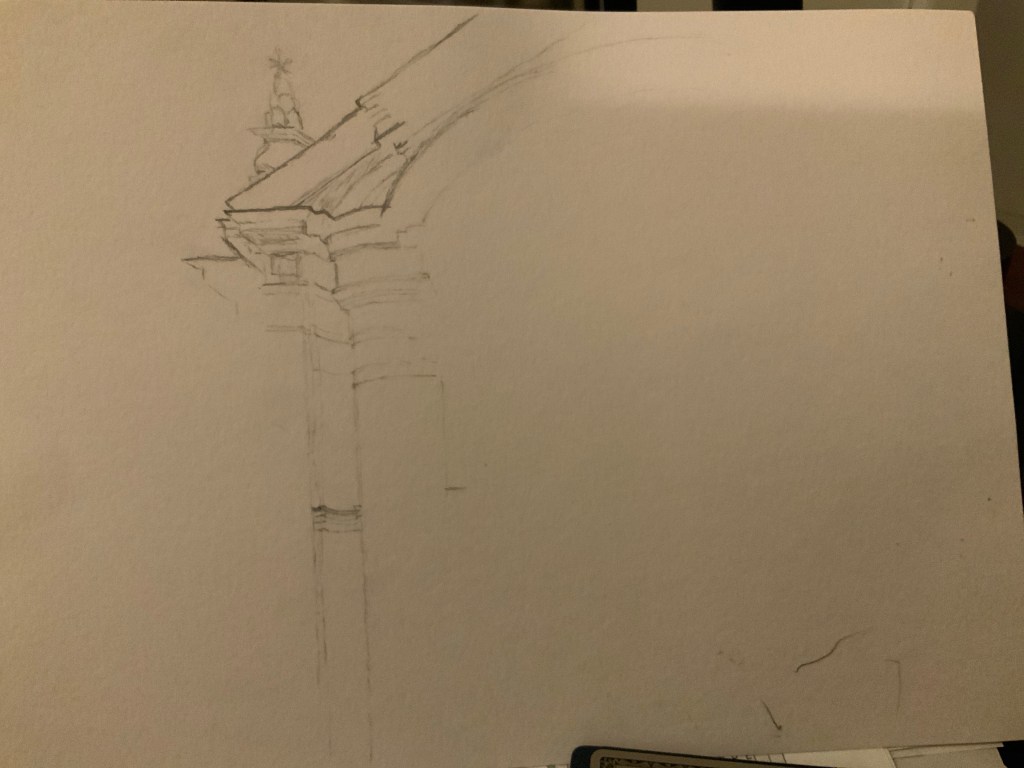
I didn’t get very far with my sketch (too much talking and trying to figure out how to draw elliptical curves and where I went wrong on the proportions, especially the top of the pillar) but maybe I will try to work on it further. In any event, I enjoyed the lesson. I will have to look into opportunities for sketching and watercolour in Calgary in real life instead of videos. Too bad there’s no buildings like this in Calgary.
After I went shopping but can’t say more because some people who might read this might get ideas of what I’m giving them for Christmas.
I did not buy anything in this store but I did see a book I’d like:
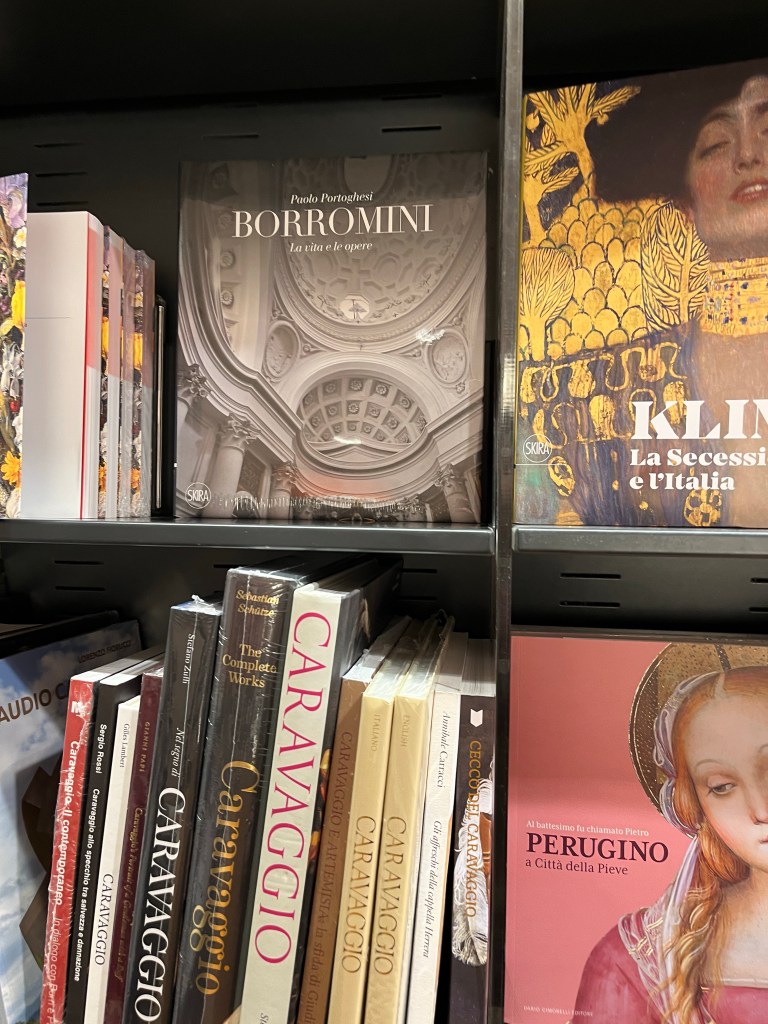
Paolo Portoghesi’s book on Borromini is huge, way too huge to fit in my luggage, so I did not buy it. It is too heavy even to carry from the bookshop. And it’s in Italian which would make it a real effort to read. I’ll have to see if it has been translated (and deliverable to my house).
The bookshop is near Il Gesù which has a famous illusionist ceiling.
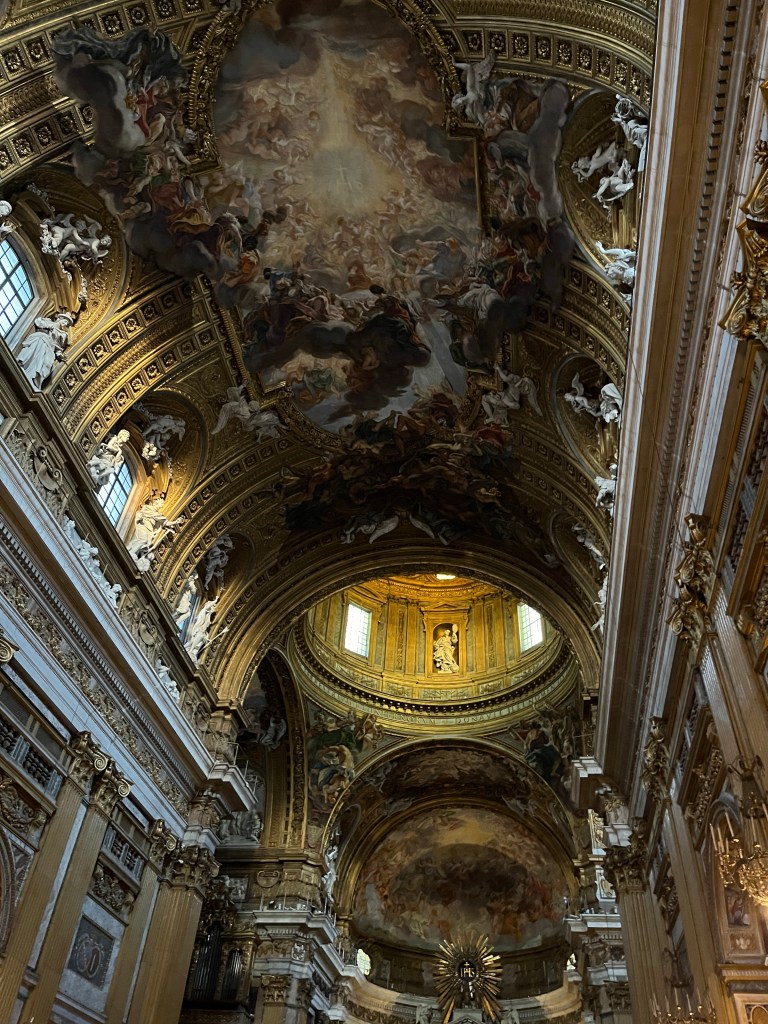
And a presepe.

I also looked into Santa Maria in Campitelli. It seemed for the size of the church, the presepe was small.


Later in the afternoon I tried a walking tour called History of the Jewish Ghetto in Rome. It’s operated through an app called Voice Map which uses GPS so that it knows when you are standing in or in front of the place that is to be described. We used it in Switzerland last year and found it worked well.
I started at the Fontana Tartaruga or Turtle Fountain designed by Gian Lorenzo Bernini, who has the big fountain in Piazza Navona in the photo at the beginning of this post and who, if you don’t know him, you will read lots more about him as his art and architectural fingerprints are all over this city.

Sadly, I learned the nobleman named Mattei for whom the Piazza is named and whose house was the building behind in the above photo, arranged to have the fountain built in front of his house instead of nearby where it had been planned. This was when the laws of Rome required every Jewish person to be locked within the Jewish Ghetto between dusk and dawn. Because he wanted the fountain in front of his house, which of course was outside the Ghetto, this resulted in no fountain within the walls of the Ghetto, in other words, no source of fresh water between dusk and dawn for the large number of inhabitants of the Ghetto. Pursuing his own vanity instead of caring about other human beings. There are other people today who fit that description.
The walk takes you past some stolpersteine, German for stumble stones, pietre d’inciampo in Italian, which mark where Holocaust victims were taken from their homes.

Of the above group, only one says the individual survived. It is interesting that while about 2000 individuals were taken from the Ghetto in Rome, many, many more were living there. Speculation is that Romans outside the Ghetto helped with escapes or hide many people.
The street Portico D’Octavia, is believed to have been at the level of ancient Roman times until World War II. The street was named for the sister of the emperor Octavius, who was ruling when Christ was born.

The bridge in the background of the photo shows current ground level. The area was only built up and walls built on the banks of the Tiber River after WWII to stop the flooding.
Old unhealthy crowded housing was replaced in one area where the major synagogue was built.

The tour goes to the museum behind the synagogue but it was closed so I paused the tour. I’ll try to go back before we leave.
As I missed lunch because of sketching and shopping, I “researched” two gelaterie. One was in the former Mattei palazzo.
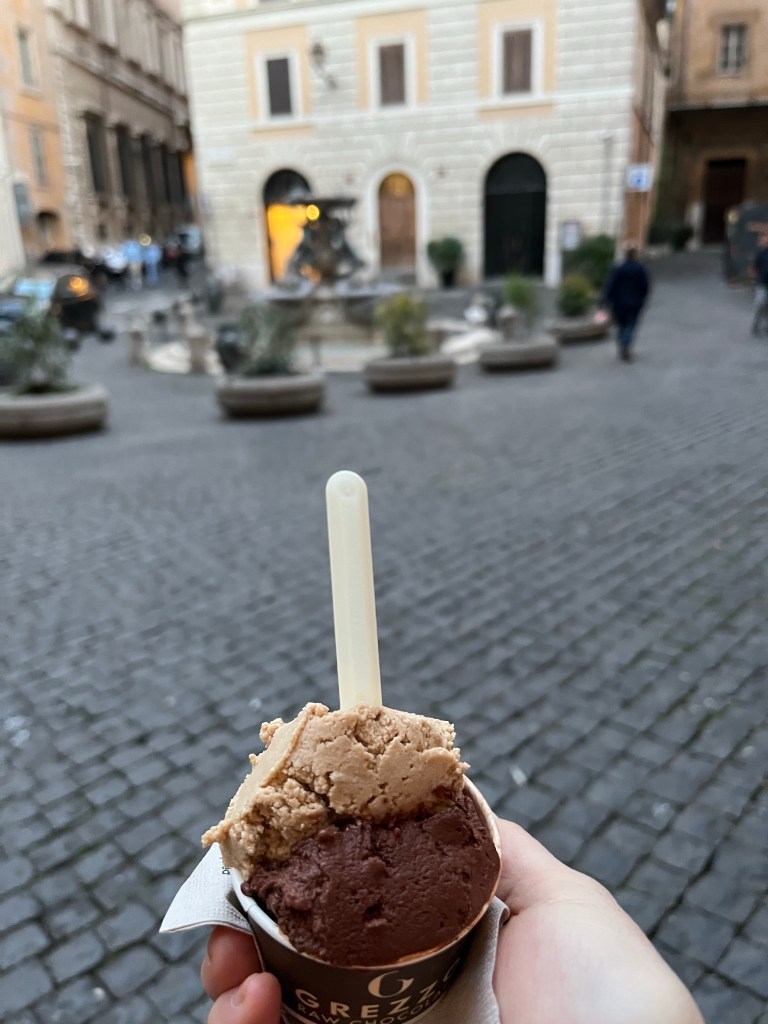
A nocciola which was a bit too sweet and cioccolato crudo or raw chocolate which was very not sweet almost like chocolate ice in texture—very different but good.
I also returned to Gelateria del Teatro for nocciola and their “pure” chocolate—both were as good as I remembered.

Nearby Gelateria del Teatro is the church San Salvatore in Lauro that has a presepe outside with life size figures.

You might notice it’s missing the birthday boy. I wonder if there’s going to be a real baby placed there on Christmas. Not sure if that would work well. Obviously this presepe is waiting for something special on Christmas.
I also bought some roasted chestnuts (castagna).

After all the gelato I had a salad and pasta for dinner. Cacio e pepe using tonarelli pasta seems popular. The pasta is a long tube, thicker than spaghetti but smaller than macaroni and very similar to bucatini which makes me wonder if they are pretty much the same but called by different names depending on where you are in Italy. Maybe it’s a bit smaller in diameter or a variation but there are some 200 plus types of pasta so I’m just guessing.
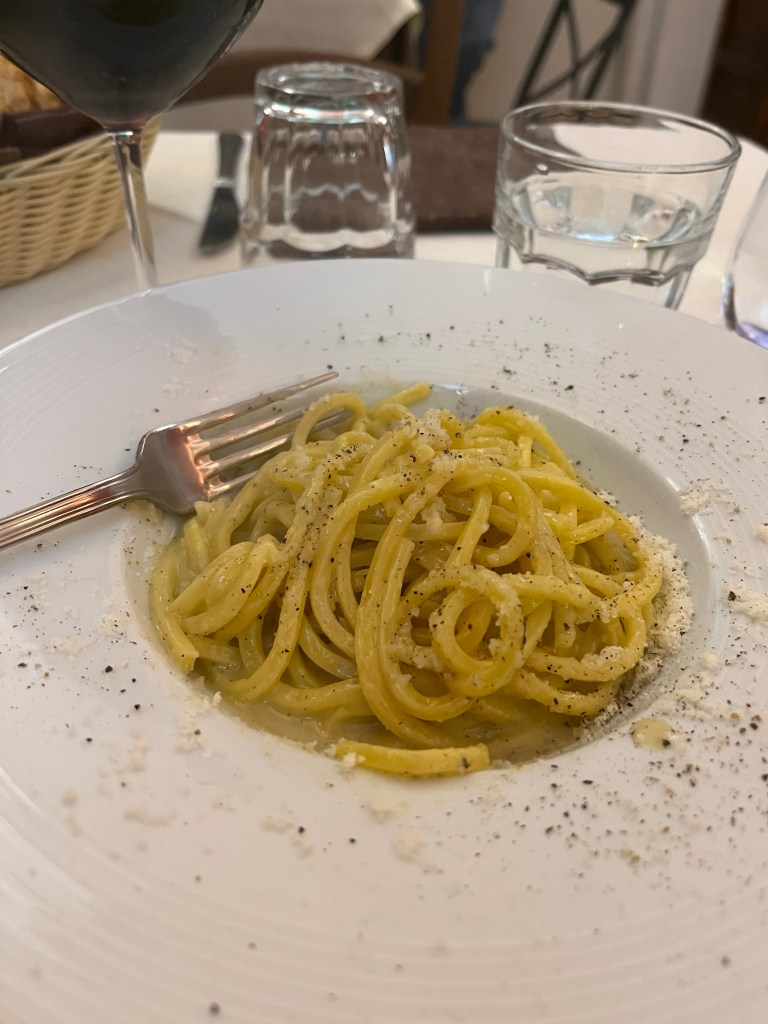
“Cacio” means cheese, possibly in Roman dialect. Standard Italian for cheese is formaggio. “Pepe” is pepper in standard Italian. If you have seen Stanley Tucci’s Searching for Italy episode on Rome, he says this dish sounds ludicrously simple as it is nothing more than pasta, cheese, pepper and pasta water. But when well made . . .
 LHWatson's Travel Blog